eBPF Use Cases Introduction to eBPF
eBPF Use Cases
eBPF has a wide array of use cases that are intended to address next-generation networking, observability, and security.
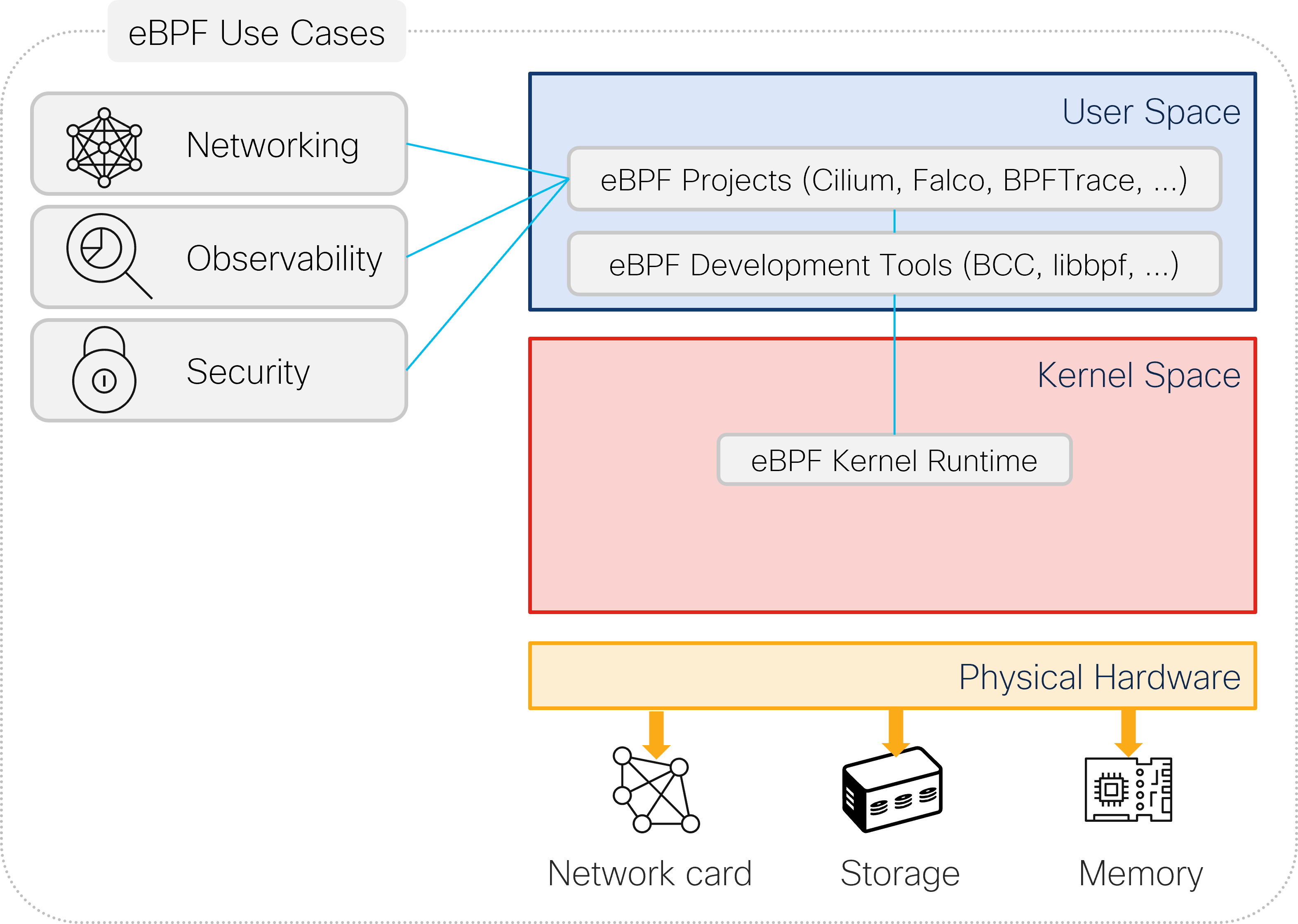
eBPF for Networking
eBPF allows for efficient and flexible networking operations. It enables the creation and enforcement of advanced network policies, traffic management, and packet filtering directly within the kernel. Primary use cases include:
- Advanced packet filtering and processing: eBPF can inspect, filter, and manipulate packets at various stages of their journey through the networking stack. This ability allows for precise traffic control and low-latency packet processing, which is critical for high-performance networking applications.
- Network load balancing: eBPF programs can be used to implement sophisticated load-balancing strategies. By executing these programs at the kernel level, it is possible to balance incoming traffic across multiple back-end servers efficiently, reducing latency and improving overall throughput.
- DDoS mitigation: eBPF enables dynamic and scalable mitigation strategies against distributed denial of service (DDoS) attacks. It can quickly identify and drop malicious traffic patterns, helping to maintain service availability during an attack.
- Virtual networking: eBPF is integral in the creation of virtual network functions (VNFs) and software-defined networking (SDN). It allows for the development of custom networking logic that can adapt to various environments and requirements without needing to modify the kernel itself.
eBPF for Observability
eBPF is a powerful tool for gaining insights into the performance and behavior of applications and systems. It provides granular visibility into system operations and application performance with minimal overhead. Primary use cases include:
- System performance monitoring: eBPF can be used to collect detailed metrics on CPU, memory, I/O, and network usage. This data helps in identifying performance bottlenecks and understanding system behavior under different workloads.
- Application profiling: By attaching eBPF programs to various points within an application, developers can gain insights into function call patterns, execution times, and resource utilization. This ability helps in optimizing code and improving performance.
- Latency tracking: eBPF can measure latency at various points in the system, such as network packet processing, disk I/O operations, and interprocess communications. This data is crucial for identifying and addressing sources of latency in distributed systems.
- Tracing and debugging: eBPF enables dynamic tracing of both kernel and user-space applications. This ability is invaluable for debugging complex issues that arise in production environments, because it allows for nonintrusive observation of system behavior.
eBPF for Security
eBPF enhances system security by providing capabilities for real-time monitoring, anomaly detection, and enforcement of security policies. Primary use cases include:
- Intrusion detection and prevention: eBPF can be used to detect suspicious activities such as unauthorized access attempts, unusual network traffic patterns, and potential exploits. It enables real-time response to these threats by blocking or mitigating the detected anomalies.
- Application sandboxing: eBPF allows for fine-grained control over application behavior by enforcing security policies at the system call level. This feature can prevent applications from performing unauthorized actions, thereby limiting the potential impact of a compromised application.
- Runtime security enforcement: Security policies that are defined through eBPF can dynamically adjust based on the runtime context of applications. This ability includes controlling access to resources, monitoring file system changes, and enforcing network access controls.
- Data exfiltration prevention: eBPF programs can monitor data flows and detect attempts to exfiltrate sensitive information. This feature helps in protecting against data breaches by identifying and blocking unauthorized data transfers.
Example Programs
Here are some example software solutions that utilize eBPF to enhance networking, observability, and security:
- Cilium is a networking and security solution for containers and microservices that utilizes eBPF to provide high-performance networking, load balancing, and security features. Cilium enables dynamic enforcement of network policies and offers deep visibility into network traffic.
- Falco is an open-source runtime security tool that detects unexpected application behavior. By using eBPF, Falco can monitor system calls and file system changes in real time, providing security alerts for suspicious activities.
- Bpftrace is a high-level tracing language for eBPF that allows users to write scripts to collect and analyze system performance data. Bpftrace is particularly useful for debugging and profiling applications in production environments.
- Sysdig is a unified platform for monitoring, troubleshooting, and securing containerized applications. It uses eBPF to capture and analyze system calls, network activity, and other critical metrics, providing deep insights into container and Kubernetes environments.
- Katran is a high-performance Layer 4 load balancer developed by Facebook. It leverages eBPF for efficient packet processing and load balancing, making it suitable for large-scale data center environments.
- BPF Compiler Collection (BCC) is a set of tools and libraries that help you monitor and analyze the performance of Linux systems using eBPF. It includes tools for monitoring, profiling, and troubleshooting. BCC makes it easier to create and use eBPF programs using Python and C.
Keep going!